
How do I cite ChatGPT and other generative AI in Cite Them Right Harvard?

The 13th edition of Cite Them Right added guidance for AI-generated material, which the 12th edition did not cover. If your department follows Cite Them Right, this is the guidance that applies to you.
Before the format, two questions decide what you actually do.
First: are you allowed to use it at all?
Referencing correctly does not make unauthorised AI use acceptable. Institutions differ, and some restrict generative AI regardless of how transparently you cite it. Others permit it for particular tasks and not for others. Check your department’s assessment policy before your referencing guide, because that is the document you will be judged against.
Second: do you reference it, or acknowledge it?
Cite Them Right separates two situations, and this is where most people go wrong.
You reference an AI tool when you have used specific content it produced: text you have quoted or paraphrased, an image you have reproduced, code you have included.
You acknowledge it, without a reference list entry, when it assisted with the process rather than supplying content. Brainstorming, structuring an argument, checking your writing. Here you say what you used and what you used it for, usually in your methodology or in a statement your department asks for.
Referencing something you should have acknowledged clutters your bibliography. Acknowledging something you should have referenced is closer to an integrity problem. If you are unsure which side you are on, ask whether a reader could point to something in your work that came from the tool.
Content you generated yourself
This is the common case: you prompted a tool and used what it gave you.
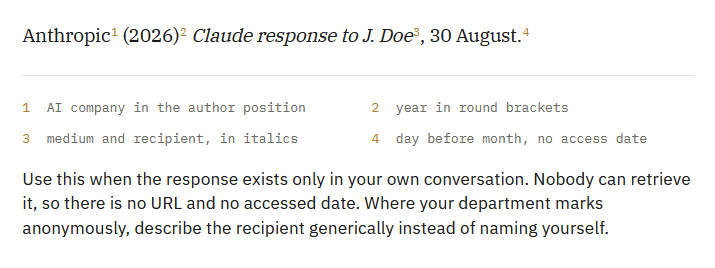
The thing to understand is that this output is not retrievable. Nobody reading your work can go and look at it, because the same prompt will not produce the same response twice, and there is usually no public URL. That is why the reference identifies the exchange rather than pointing to a source, and it is also why many departments ask you to include the full prompt and response in an appendix. Check whether yours does.
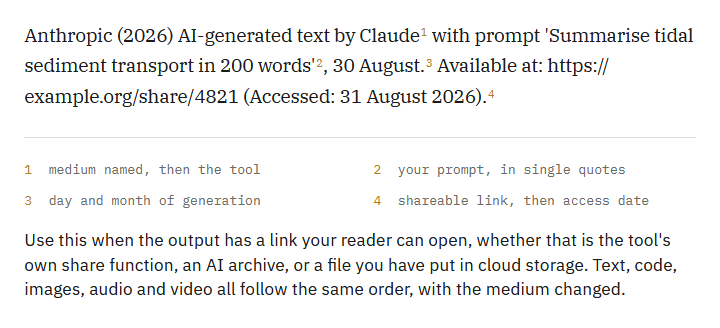
In case you do have a shareable link (certain tools do), then a citation should look like as follows:
AI content you found online
Different situation, and a lot of people miss it. If you did not generate the content yourself but came across it published somewhere, you do not use the AI reference format at all. You use the normal format for whatever medium you found it in, with the AI company as the author.
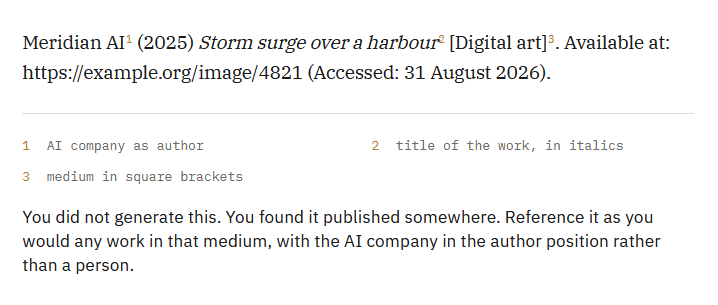
An AI-generated image on a stock library is referenced as an image. An AI-written article on a website is referenced as a web page. The only difference is who goes in the author position.
Which Zotero item type should you use?
Here is the practical problem nobody mentions: Zotero has no item type for an AI tool… yet.
Whatever you choose, you are borrowing a type designed for something else, and the fields will not line up neatly with what the reference needs. The choice matters, because your style reads specific fields for specific positions. Put the company name in the wrong field and it will not appear where the author belongs, or will not appear at all.
Our Cite Them Right 13 style uses the item type Software as it’s most closely related and will produce the correct output for you automatically.
If you are still on a 12th edition style
The 12th edition predates all of this. If your reference manager is set to a 12th edition style, it has no AI handling to fall back on, and has more changes as well.