
Cite Them Right 12th to 13th edition: what changed, and what it means for Zotero
Last checked against the 13th edition: 30 August 2026
The 13th edition of Cite Them Right was published in 2025, and most UK institutions have now moved their guidance across to it. If your reference manager is still producing 12th-edition output, your bibliography is out of date, and not always in ways you would notice by looking at it.
This page sets out what changed, what each change does to references you have already collected, and what your options are in Zotero.
Summary
| Change | What it affects |
|---|---|
| Place of publication removed | Books, edited books, chapters, conference proceedings |
| Reference list titles in sentence case | Every reference you have |
| “Article” replaces “article number” | Journals that number articles rather than pages |
| Optional paragraph numbers in citations | Online sources with no page numbers |
| AI tools: reference or acknowledge | Anything produced with generative AI |
| New digital source types | TikTok, Teams and Zoom meetings, recorded lectures & more |
1. Titles in the reference list now use sentence case
This is the change with the widest reach and the one most people have missed. In the 13th edition, titles in the reference list take sentence case, while titles used in the body of your text take title case. Previously, the same casing was used in both positions.
Why it matters: it touches every reference in your bibliography, not just books. It is also not a data problem. The casing is applied by the citation style at the point the bibliography is generated, so a 12th-edition style will not produce it however clean your records are.
It is also close to invisible. A miscased bibliography looks entirely normal at a glance. It tends to surface at marking, not before.
2. Place of publication has been removed
Like Chicago, APA and Turabian, references to books, edited collections, chapters and conference proceedings no longer carry the city of publication. The publisher’s name alone is sufficient.
This one is easy to spot in your own output, which is why it has become the shorthand for “my style is out of date”. It is worth being clear that it is one change out of six, and the only one that is obvious on sight.
3. Journal articles with article numbers
Journal assign article numbers in place of page ranges more and more commonly. In such cases the 12th edition of the style would produce something like “p. a56793” which is obviously wrong. The 13th edition wants you to only use the number, e.g. “a56793”.
4. Paragraph numbers in in-text citations
For online sources with no page numbers, the 13th edition recommends the optional use of paragraph numbers in in-text citations.
5. AI tools: reference or acknowledge
The 13th edition draws a distinction that trips people up. You reference an AI tool when you have included specific content it generated. You acknowledge it, without a reference-list entry, when it assisted with something like brainstorming, structuring or checking your work. Getting this the wrong way round is more consequential than a formatting error, because it touches academic integrity rather than presentation. Check your department’s own policy first. Some institutions restrict generative AI regardless of how you cite it.
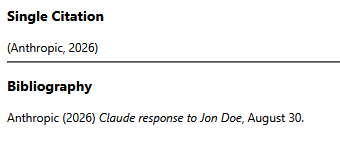
Zotero has no item type for an AI tool, which raises a separate practical question about where the details actually go. However, the item type “Software” is what we’ve used in our version of CTR13 and works well to deliver the correct output as shown below:
6. New digital source types
The 13th edition adds guidance for source types the 12th did not cover, including:
- TikTok
- Zoom and Teams meetings
- Recorded lectures
- AI-generated images, code and video
What to do about it
You need correct references following CTR 13? You have three realistic options:
Carry on with the 12th edition. Some departments will accept 12th-edition referencing, particularly for students who began their course under it. Several university libraries have said publicly that consistent, traceable referencing is what matters most. Ask before assuming. This is a departmental decision, not a general one. But do check first as it can otherwise lead to unnecessary point deductions.
Edit the 12th-edition style yourself. Zotero’s built-in style editor lets you copy the 12th-edition style and save your own version. If you are comfortable working in a style sheet, this is a route worth considering, although note that we have spent countless hours getting our style match CTR13 exactly.
Be clear about what it involves. Each of the six changes has to be handled separately, and they are not equally difficult. Casing and the new source types are substantially more work than the others, and there is no way to check your result short of comparing output against the specification yourself.
Use a maintained 13th-edition style. Every source type, rendered in full, so you can check the output against your own requirements before deciding anything.